

Ole Miss head coach Lane Kiffin’s eldest daughter, Landry Kiffin, has unexpectedly gained notoriety for her on-field exploits but rather for her life narrative, which combines family dynamics, athletic heritage, and young independence. She was born in or around 2005, is a member of the sorority Kappa Kappa Gamma, and attends the University of Mississippi. Her social media presence is steadily expanding, and she shares pictures of her time as a student along with lighthearted jokes about her father.
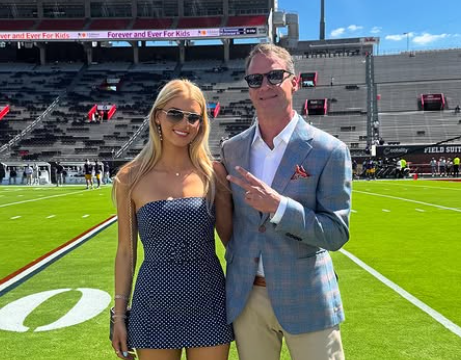
She gained more public attention recently when it was revealed that Landry was seeing Whit Weeks, an LSU standout linebacker. Shortly before the yearly Ole Miss-LSU game, the information was leaked on social media, transforming a private statement into a storyline interwoven with one of the most intense rivalries in college football. The involvement of a head coach’s daughter with a standout from the rival school adds a dimension of dramatic irony, resembling a scene from a sports movie with real-life ramifications.
Lane Kiffin Family Snapshot
| Name | Role/Detail |
|---|---|
| Lane Kiffin | Head Coach of Ole Miss Rebels Football |
| Landry Kiffin | Oldest daughter (born ~2005), student at Ole Miss, member of Kappa Kappa Gamma |
| Pressley Kiffin | Younger daughter, freshman at USC, plays volleyball as an outside hitter |
| Knox Kiffin | Youngest child of Lane Kiffin |
| Relationship | Landry confirmed dating LSU linebacker Whit Weeks |
| Notable Rivalry | Ole Miss vs. LSU — high‑stakes SEC matchup |
Pressley, her younger sister, follows a different but no less honorable path. Pressley, who is a USC student and an outside hitter in volleyball, is navigating her own academic path. Her choice to enroll at the same university where her father was a coach highlights how the family’s values of education, athletics, and individual aspirations are intertwined. Pressley is the next chapter, one that is less about making headlines and more about performance and development, even though he is less vocal in public than Landry.
The sisters’ differences show how families change throughout time. Landry’s sorority life and dating news portray her as both a part of and a departure from her father’s public persona. Although she is contributing to the coach’s legacy, she is also creating something of her own. Jokes directed at her father can be found in her social media feeds, indicating a positive dynamic rather than one governed by rigid etiquette. In sports families, where the coach-child interaction is frequently intense, closely controlled, and invisible, this kind of relationship is especially creative.
Landry’s decision to date a rival player in public raises concerns about if this is a sign of independence, a juvenile rebellion, or just a young adult connecting? For Lane Kiffin, who is accustomed to deciphering press releases and playbooks, this instance gives a professional image a human touch. Although the relationship doesn’t alter game strategy, it does highlight the ways in which private lives and public achievement in collegiate athletics interact.
It also discusses how athletes’ and coaches’ kids deal with identity. In the past, coaches’ kids lived in the background, silently watching games and maybe joining the squad, but they hardly ever made news on their own. That is not the case with Landry’s story. She is more than just the daughter of a coach; she is a young adult in a relationship with social resonance, a student, and a member of a sorority. By doing this, she questions preconceived notions about what it means to be a member of a sports family.
Unquestionably, the public announcement was timed strategically. Days before a high-stress SEC clash, it sparked emotions ranging from lighthearted to furious. Media sources questioned whether this personal revelation would add emotional fuel to the game, rival supporters taunted, and fan forums exploded with memes. The way that personal and professional are layered highlights the current intimate relationship between cultural identity and collegiate football.
Additionally, this story mirrors broader societal trends: young adults are no longer shrouded in secrecy. Athletes, influencers, and their families intentionally reveal aspects of their life to shape their public personas. Even though it is quite little, Landry’s online presence contributes to this change. She uses the platform to define herself as Landry—a student, friend, and young lady making decisions—rather than just as Lane Kiffin’s daughter.
The father-coach, Lane Kiffin, may perceive this as a parallel game taking place off the field. He is accustomed to managing rivalries, leading a team, and making crucial decisions. He is currently watching his daughter negotiate her identity in light of the same rivalry. The way that well-known coaches’ families strike a balance between their private lives and public personas is becoming more and more important, and Lane Kiffin’s family serves as a real-world illustration of this.
The narrative raises important questions about generational shifts that go beyond the headlines. While their father continues to be a prominent figure in collegiate athletics, the sisters are maturing. In a time of increased visibility, social media, and expectations, they are blazing their own trails. In contrast to earlier generations who could have subtly played the coach’s kid, Landry and Pressley actively participate in their own story. For young people in sports families who are looking for independence, that evolution is very helpful.
The story of the Kiffin family keeps developing as Pressley gains expertise on the volleyball court at USC and Landry navigates her academic and social life at Ole Miss. It’s about identity, freedom, and the decisions that follow youth, not just about wins or losses on the pitch. Whether Landry’s relationship with Weeks is a long-term story or a moment in college life, it already represents a big change: the intersection of current identity and sporting legacy.
The notion of separating one’s personal life from one’s professional identity is frequently reiterated in coaching circles. However, that line is brittle for many families in high-stakes sports. According to Landry’s social media activity, relationships, and public persona, boundaries are changing rather than going away. Children of coaches are trailblazers in the realm of families navigating both the public and private domains.

blink plus plan with monthly auto-renewal
$11.99 (as of March 30, 2026 21:00 GMT +00:00 - More infoProduct prices and availability are accurate as of the date/time indicated and are subject to change. Any price and availability information displayed on [relevant Amazon Site(s), as applicable] at the time of purchase will apply to the purchase of this product.)
Ring Floodlight Cam Wired Plus (newest model), Outdoor home or business security with motion-activated 1080p HD video and floodlights, White
$89.99 (as of March 30, 2026 21:00 GMT +00:00 - More infoProduct prices and availability are accurate as of the date/time indicated and are subject to change. Any price and availability information displayed on [relevant Amazon Site(s), as applicable] at the time of purchase will apply to the purchase of this product.)
Amazon Echo Spot (newest model), Great for nightstands, offices and kitchens, Smart alarm clock, Designed for Alexa+, Black
$37.49 (as of March 30, 2026 21:00 GMT +00:00 - More infoProduct prices and availability are accurate as of the date/time indicated and are subject to change. Any price and availability information displayed on [relevant Amazon Site(s), as applicable] at the time of purchase will apply to the purchase of this product.)
blink plus ai plan with monthly auto-renewal
$19.99 (as of March 30, 2026 21:00 GMT +00:00 - More infoProduct prices and availability are accurate as of the date/time indicated and are subject to change. Any price and availability information displayed on [relevant Amazon Site(s), as applicable] at the time of purchase will apply to the purchase of this product.)
Amazon Kindle Paperwhite 16GB (newest model) – 20% faster, with new 7" glare-free display and weeks of battery life – Black
$118.79 (as of March 30, 2026 21:00 GMT +00:00 - More infoProduct prices and availability are accurate as of the date/time indicated and are subject to change. Any price and availability information displayed on [relevant Amazon Site(s), as applicable] at the time of purchase will apply to the purchase of this product.)
Amazon Kindle Paperwhite and Kindle Colorsoft Case, Lightweight and Water-Safe, Foldable Protective Cover - Fabric
$18.25 (as of March 30, 2026 21:00 GMT +00:00 - More infoProduct prices and availability are accurate as of the date/time indicated and are subject to change. Any price and availability information displayed on [relevant Amazon Site(s), as applicable] at the time of purchase will apply to the purchase of this product.)
Blink Video Doorbell (newest model) – Head-to-toe HD view, two-year battery life, and simple setup. Required Sync Module not included – Add-On (Black)
$22.49 (as of March 30, 2026 21:00 GMT +00:00 - More infoProduct prices and availability are accurate as of the date/time indicated and are subject to change. Any price and availability information displayed on [relevant Amazon Site(s), as applicable] at the time of purchase will apply to the purchase of this product.)
Ring Indoor Cam Plus (newest model), Home or business security, Retinal 2K for crisp, true-to-life video quality, 4x Enhanced Zoom, Low-Light Sight, White
$39.99 (as of March 30, 2026 21:00 GMT +00:00 - More infoProduct prices and availability are accurate as of the date/time indicated and are subject to change. Any price and availability information displayed on [relevant Amazon Site(s), as applicable] at the time of purchase will apply to the purchase of this product.)
Amazon Echo Show 11 (newest model), Vibrant Full-HD 11" display with more viewing area and spatial audio, Designed for Alexa+, Graphite
$169.99 (as of March 30, 2026 21:00 GMT +00:00 - More infoProduct prices and availability are accurate as of the date/time indicated and are subject to change. Any price and availability information displayed on [relevant Amazon Site(s), as applicable] at the time of purchase will apply to the purchase of this product.)
